Our "20 Year Project". We're looking forward to building our brand new garden, year by year, from almost scratch. Apart from a few very small trees, our newly acquired tract is currently only a bare stretch of grass. So starting July 23rd, 2007 when we take possession it's "on with the show" ..... and please come back often and watch us grow!

Tuesday, September 11, 2007

More Perennials Planted and/or Potted Today

Day Lilies
Hostas
Fern
Strawberries
Raspberry Cane
Lily-of-the-Valley
Iris
On Kijiji, (where else!), Mar found Melinda, a nice gardener in St. Catharines, selling perennials for a dollar a piece, which is far less than any garden centre.
We picked up the ones pictured above and have planted or potted them around the garden.
We are not sure where anything will finally end up, so we have plants scattered here and there until we can decide where each should be placed permanently.

Yikes! Get Thee to WalMart!


Holy Smokes! Yesterday, there were tons of deals in what was left of the Garden Department at one of our local WalMarts. Seems they are clearing everything out as fast as possible to make up a Halloween Department ....
In addition to many garden hand tools for a buck a piece, we bought Ruth a bird feeder and bags and bags of red bark mulch to fill the paths we're creating throughout the garden.
Pictured above is the bird feeder we'll have to get up today and what the first bag of mulched bark looks like on the path we started on the east side of the berm.
The huge bags of red mulch bark were marked down to $2.50 from I think $6.99, so if you have an inclination to cover a football field, now is the time to do so!

Monday, September 10, 2007

Don't be Shy! Please Share!

Mar and I ... as we're sure many others would ... like to see some of your gardens out there!
Our E-mail address is at the top of the left hand margin.
Let's see (literally) the fruits of your own labours ... and flowers, and vegetables, and designs, and all your garden stuff.
Start clicking!

Saturday, September 8, 2007

A Mighty Locust

(click on this image to maximize the immensity
of the canopy .. being underneath it is nothing
less than extraordinary!)
Today Mar and I were visiting an art show held annually on one of our town's boulevards. The residents have to be some of the most patient people on earth as thousands of art lovers and buyers cram their street from 9AM to 5:30PM.
Since we just planted four of our own locust trees we spotted this sitting in a backyard, towering over one of the homes. As luck would have it, or is it irony, not only did I recognize the resident, but she also has a business called, get this, "Garden Creations"!
Before long our search for art was on hold and we were getting a fabulous tour of their gardens, both in the front and back yards.
While in the back Mar snapped these shots of the locust, estimated to be about 120 years old.
We don't think we'll be around to see our four newly planted locusts become this large!
I'll have to go back this week and snap some images of their perennials. They were beautiful.

Our Bes Pine

We took a close up tonight of the new pine we transplanted yesterday, giving it a spot front and centre in our garden. Naturally, it was only fitting we call it Bes.
We have added a solar light so we can see it from our patio window 24/7.

In Loving Memory of Bes

(l to r) Ruffy, Scruffy and Bes
An extended member of our family, one who was frolicking all over our new garden just last week, was put to sleep yesterday, a kind act, as cancer had spread too far into her gentle being.
"Bes" was an acronym of B for Brian, E for Elizabeth, and S for Samantha, the three children who grew with Bes, from toddlers next door at our old house, to 'Sam' now in college and Brian and 'Liz' both in high school.
Bes had a great life, including innumerable sleepovers at our house as her own family were world travellers, (hey, I should work for Air Canada too!).
Almost daily, Scruffy would start to agitate at the front door ... Bes would come over by herself to play. (Scruff reciprocated this ploy too.)
She also figured out how to get into our house, first through the baby gate used to keep Ruffy, the wannabe runaway penned, then through the loosened screen we devised allowing our two free entrance into and from the back yard.
Just before we moved one night at 11PM, we mounted the steps to go to bed, and there was Bes in her favourite spot at the top of the stairs. Who knows how long she had been there! She came for a sleepover on her own!
We were especially blessed a week ago. Her family went to PEI for the week and Bes came to spend that time in our new home with us. She spent hours and hours checking out the new garden! Little did we know just how soon the end was ... that we would share the second to last week of her life. That will always be extremely special to us!
Bes, you had a great life Girl and gave our own family countless hours of joy playing with you and watching you grow with Scruff and Ruff.
Fittingly, we think, we are calling that little pine we transplanted yesterday into the centre of the garden: Bes.
It will be a constant reminder to us of one of the smartest sheep dogs we ever came to know and love.

..... from our E-mailbag : from Longueuil, Quebec ~ "For Bes and her family"

Bet you're having a great time racing through the meadows in your new home Bes, you good girl, you!
Brodie and Sue LP
(Ed note ... Brodie walks on four legs!)

Rainbow Bridge

Just this side of heaven is a place called Rainbow Bridge.

When an animal dies that has been especially close to someone here, that pet goes to Rainbow Bridge.
There are meadows and hills for all of our special friends so they can run and play together.
There is plenty of food, water and sunshine, and our friends are warm and comfortable.

All the animals who had been ill and old are restored to health and vigor; those who were hurt or maimed are made whole and strong again, just as we remember them in our dreams of days and times gone by.
The animals are happy and content, except for one small thing; they each miss someone very special to them, who had to be left behind.

They all run and play together, but the day comes when one suddenly stops and looks into the distance. His bright eyes are intent; His eager body quivers. Suddenly he begins to run from the group, flying over the green grass, his legs carrying him faster and faster.

You have been spotted, and when you and your special friend finally meet, you cling together in joyous reunion, never to be parted again. The happy kisses rain upon your face; your hands again caress the beloved head, and you look once more into the trusting eyes of your pet, so long gone from your life but never absent from your heart.

Then you cross Rainbow Bridge together....

Author unknown...

Right Place, Right Time!

Last week our resident Kijiji Queen found a chez lounge for Ruth, (not pictured), in Hamilton being sold by a wonderful couple, Jayne and Chris.
During the course of the mandatory socilaizing done when Kijiji buyers and sellers get together for the exchanges, we mentioned we were doing our whole sloped garden in multiple flower beds, all framed in limestone.
BINGO!!! They took us around to the side of their home and said take all you want. Along the foundation, down the whole length of that side of the house, was has to be tons and tons of perfect limestone rocks, all neatly stacked! Most are quite square, (making their origin direct from a quarry a high probability), but who cares .... they turn amateur masons into instant professionals.
Pictured above is our first haul.
If you are passing through this weekend, bring a strong back or two! It's good for a glass or more of local grape!

<><><><><><><><><><>
Fast forward to later in the day .....

The Bonsai Garden rocks have company!
We have used about one half of our latest limestone rock supply to build the next stairwell up the berm. This one leads into the pathway being cut out in front of the first locust and scallop of limestone rocks encircling it.
We also did a transplanting of the little ground pine in the left centre of the photo. It was growing on the east side of the house in a "no man's land" area, totally unseen or enjoyed. Now it has taken centre stage in the garden. Hope it survives and thrives.

The Lighter Side of Gardening!

Friday, September 7, 2007

Moe's Beautiful Gardens

Sue LP has graciously sent in these many pictures from Moe's Garden.
Maureen "Moe" Holden was the Champion of our home town of Greenfield Park, Quebec ... who would not let a half-century old travesty die, who started our drive to bring peace and grace to the many, many Victims STILL suffering from the molestation of our Town's pedophile Anglican priest, Walter Bockus.
Sadly, Moe lost the battle to cancer last year and asked that her ashes be put to rest in this garden.
We all miss you big time Moe!


Thanks for the images SueLP!

..... from our E-mailbag : From British Columbia

The Butchart Gardens
Hi Mike & Mar,
Congratulations on your garden - it is looking great and will look even better next year.
Have you ever tried taking your pictures to a garden centre or horticulture society to have identified? They will be more than happy to answer your enquiries.
Or was that a quiz question for your followers of Gardenmania?
I am sorry but I cannot answer your question.
Went to Minter Gardens in Chilliwack last week with my visiting sisters and never before saw so many varieties of just their roses alone never mind all the other plants they had their . . . lol
Monika
----------------
Hi Monika
Thanks for joining us in our garden!
We are hoping to learn all the names of the things we cannot identify through our readers ... yes, it is as much of a quiz as a learning thingie.
My own favourite public gardens are the Royal in Hamilton, Ontario, the Butchart on Vancouver Island, and the Andromeda in Barbados.
Best,
mike

Thursday, September 6, 2007

Last Night's HORRIBLE Garden Experience


Poor Little Ruffy This Morning:
Still Shell-shocked and
Smelling Like a Pickle!

Last night, way after our normal too-late bedtime, (compounded by yours truly having just stood for three hours in a cold arena in fall, - not still-unpacked winter - clothes ...... watching Michael trying out for a Junior hockey team), Ruffy indicated nature was calling one more time. (Hey, I know that sentence probably broke all the rules, stroke it up to literary license. Hahaha)
Now where was I? Oh ya, it was in reality already today when I let Ruffy out the back patio door to once again, to my chagrin, probably lift a leg on one of our new prized perennials.
Already half dopey yearning a pillow I was suddenly brought back to full attention by his barking in a new-found decibel range.
Turning on the backyard light I was horrified to take in a scene that happened in a micro-second, all beyond my control, which amounted to the highest pitch I have ever screamed, "R-U-F-F-Y".
It is amazing all our new neighbours did not collectively dial 9-1-1 on their bedside table phones when this one happened.
Up there on the berm, about 30 feet, tops, from the door in which I was framing with my body in horror, he had pinned a skunk up against the planter bench, (our 2008 project), howling his head off. In that micro-second the skunk pirouetted, lifted its tail, and went into maximum defensive mode.
Last night was not calm. There were gentlle little breezes swirling in our yard delivering the net result of all this boisterous action to my nose faster than you can say, "The Toronto Maple Leafs are perennial losers".
Next, Ruffy came yelping down the berm, headed for the door which I was closing as fast as a train.
Meanwhile, Mar had amazingly put 2 and 2 together without full knowledge of the facts. Entering the family room, she saw Ruffy begging to come through the glass and the one-who-should-have-been-in-bed standing there dazed, confused and totally unsure of what to do next.
Praise the Internet! We both immediately rushed to the office to ask Father Google for advice and in seconds came up with a cocktail of vineger, baking soda, and one teaspoon of detergent, the latter supplying the ability to break through the skunk oil Ruffy was now trying to get off his face by plowing his nose and eyes through the grass next to the back door.
Let me tell you: washing a dog in a vinegar solution in the wee hours of today out on the back deck, rather than being on our fresh, puffy pillows brought the bar WAY down on this home's state of happiness.
Anyone out there wanna buy a stupid dog today? He smells like a damn pickle.
Scruffer says he's dumber than a cat!
<><><><><><><><>
Responses

Dear Ruffy,
You are not alone...I too was attacked recently by one of those stinky little rascals. I was just soooo humiliated as you can see by my face in the picture....
My humans just swear by the following recipe. It really, really works and you won't smell like dill pickles afterwards!
Your friend,
Brodie

Skunk smell removal formula:
1 quart of peroxide
1/4 cup baking soda
2 tablespooons dishwashing liquid

(can double or quadruple recipe as needed for size of dog)

Mix ingredients in OPEN container, and pour on the dog. Rub into the coat and let stand for a few minutes. The odor will disappear almost immediately. Rince well.

It *really* works. It's far more effective than tomato juice, etc.
*WARNING*:
Don't try to store the solution in a closed container or make it up ahead of time. It creates a chemical reaction that only lasts a few minutes but it throws off massive quantities of oxygen so if you try to bottle it, it will explode.

<><><><><><><><><><>
Oh ya, poor Ruffy this and poor Ruffy that!
Everyone is coo cooing that dumb pure bred cocker today. Like, has anyone stopped to think that it was I, the Scruffmeister, who had to sleep all night with that foul-smelling pickle???!!!

Scruffer

..... from our E-mailbag : From Greenfield Park, Quebec


Hi Mike,
Here are some flower pictures that I took.
I did not know that you were are gardening enthusiast. Do you find it relaxing? I am a really lazy gardener, just take the pictures of other people's gardens. Ha ha.
Best regards,
Gail
Hi Gail,
Thanks for such great shots ... you are a remarkable photographer.
Yes, I have a love for flowers. (In fact, in the mid 1970s, I purchased McKenna's Florists in Montreal.)
Keep those images coming!
Best
mike

The Lighter Side of Gardening!

Wednesday, September 5, 2007

Welcome Thelma ... You are a Major Inspiration

Mar and Mike took time off from their gardening this weekend because Mike's cousin Ros was visiting from Longueuil, Quebec on a whirlwind Labour Day weekend holiday in the Golden Horseshoe and a bit beyond.
Ros visited London, Oakville, Hamilton, Niagara, North York and Markham.
Now what has this got to do with our gardening site?
Mar and Mike escorted Ros on a few of her stops, including her last with Thelma, pictured above at her computer.
Thelma was very interested in our garden and so we visited Gardenmania! together, in her home, explaining our progress to date.
She wanted to retain Gardenmania!'s web site address to maintain a watch on our progress ... so when you read this Thelma ... Hi Again! ... and thanks for hosting us in your home!
Now here's the inspiration we received from Thelma.
Last year she purchased her first computer and learned how to use the internet. What is so remarkable about this? Thelma just celebrated her 95th birthday and is enjoying life to the fullest. She communicates with people all over on-line and is throughly enjoying the benefits of the virtual world.
This should be an inspiration to all of any age too anxious to try. Thelma proves you're never "too young" to get on-line!

Tuesday, September 4, 2007

Taking Shape ....

Here's the latest shot of our garden's southeast corner.
After a few week's of work, don't you think it is definitely taking on character?
We have moved in tons, (yes tons), of Niagara limestone which flat grey colour blends in nicely, not distracting from the flowers and greenery. Over the years we'll be bringing in tons more rock for bordering and retaining walls.
Grow plants, grow!

Monday, September 3, 2007

Happy Labour Day!

May all your expectations come
to flower and fruit and greens!

Mar and Mike and Scruff and Ruff

Sharing Our Garden with Visitors from Around the World

We noticed that today at 7:04:16 am, EST, someone from Hong Kong visited Gardenmania! That is the fifteenth country to do so. Welcome!
How could we ever explain to Gram, an amazing gardener who passed away in 1964, that people from all over the world share our flowers virtually every day? Amazing.

The Root of Mike's Gardening Bug

My Gram is pictured on the right with her sister is this undated photo taken in the early 1900s.
They were born in Bermuda, emigrated first to England, then on to Montreal, Canada, and finally to the "South Shore" of Montreal in Montreal South, (annexed to Longueuil, Quebec in 1958).
Imagine coming from the little island of Bermuda where land is so scarce, and at a premium, to the vastness of Canada!
Gram bought a home on about 1/2 an acre and dug in. As a child I remember visiting almost every summer day and playing in her vast flower beds, which always took top prizes in the St. Lambert Horticultural Society's annual judging.
I can see her bent over weeding and pruning for hours on end, but always taking time to explain the art of gardening to her young grandson, usually over high glasses of ginger ale with an added scoop of ice cream.
Thanks Gram! I'm carrying on ....

Sunday, September 2, 2007

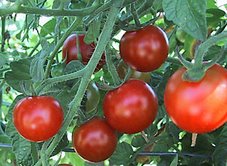
Two Cherry Tomatoes That Didn't Make it Into the House Today ... They Were YUMMY!!!!

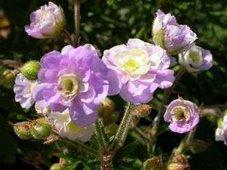
Help! What is this Flower/Bush?

What is this beautiful flower / bush ... called?
For the most part, our new home came with lawn, but in one corner there were several different species of flowers, ground cover and bushes - most of which seem to flower.
This week this one bush came out with these two beautiful flowers. They are about two inches wide with very thin petals.
Can anyone identify them?
The leaves are almost the same shape, colour and size of apple tree leaves.
There's more to identify. We'll add those in the coming days too ...
(Wish Gram was still here ... she could always identify anything!)

Can Anyone Identify These Roses?


There are so many rose varities it is probably impossible to identify some.
We have inherited about six rose plants from the former owner.
None of them had been deadheaded at all this year, so none were in bloom.
When we arrived we pinched off all the old dead flowers and now they are just starting to show their colours!
Perhaps a rose specialist will see these picks and identify them for us.
We'll post them again when they reach full bloom.

The Berm Path has Begun!

This weekend we have started the long path from the east end of the berm, starting from the top of the stairway we built on Friday.
When it is finished, (probably when we're 90!), ending at the base of the Vegetable Garden, it will be well over 100' long.
For the most part it is solid clay mixed with lumps of ashphalt, dumped there 18 years ago when the developer built the berm and privacy wall. In fact the clay allows us to carve the path and give it character.
This two dimensional image does not show height well, (especially since it was taken from on top of a chair!), but on the right you can see part of the new stairway reaching the top of the berm and from the middle to the left, the start of the path.
This path will wind in and out of The Jefferies, (our new four locust trees), and through a garden of bushes, annuals and perennials.
There are several roses, perennials and other bushes already planted in this east end, although we have not identified them all. They had been "let go", so they've all been trimmed and look great in their "new home".
We don't know what to use on the pathway ... there are so many neat things available today ... so for now it will just be hard clay.

Greetings from the Niagara!

Greetings from the Niagara!
Enjoying a hike on the Bruce Trail near our home.

Contact Us

marandmike
AT
sympatico
DOT
ca

Welcome to All Green Thumbs!

Welcome to All Green Thumbs!

This is Marilyn & Mike

This is Marilyn & Mike

This is Definitely Mike!

This is Definitely Mike!

Handy Gardeners' Plant Database Search Engine

Search HortiPlex:

Handy Image Search Engine

Example: Type in "rhododendron" and see the exquisite results! Have fun with virtually any image search!

Gnome Sweet Gnome

Gnome Sweet Gnome

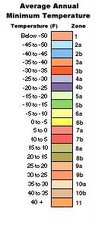
Hardiness Zone Colour Legend

Hardiness Zone Colour Legend

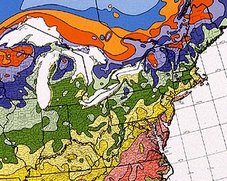
Hardiness Zone Map ~ Great Lakes

Hardiness Zone Map ~ Great Lakes

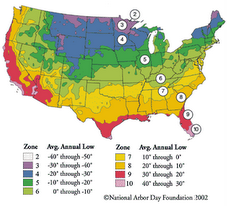
Hardiness Zone Map ~ USA

Hardiness Zone Map ~ USA

Wish List

New Word Coined by Gardening Author

"Hortgasm" - A hortgasm is what a garden fanatic has when sighting a particularly beautiful specimen. ~ James Dodson, Beautiful Madness, Penguin Group, 2007

Great Source for Japanese Maples and Bonsai

Alan Trafford
* Tel (905) 309-1697
* E-mail atrafford@hotmail.com
* Also maintains stall every Sunday at Jordan Market, Jordon, Ontario

Great Source for Perennials!!!!

Cindy Ripley
6 Nursey Lane (No Kidding!)
Fonthill
905-892-5598
cindyripley@hotmail.com
Best call or E-mail for an appointment

We bought 45 plants for $30 on July 10/07.
That has to be the best price anywhere!
She has them growing in her garden, plus has pictures of all, so great way to choose your own.
HIGHLY RECOMMENDED!

Are You a Visiting Gardener? Please Sign and Comment on Our Guestmap!

~ Visitor Count ~ Thanks So Much for Dropping In! Come Again! And Again!

Cluster Map Showing Origin of Our Visitors

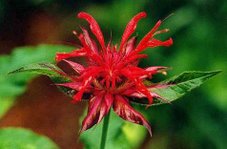
Bee Balm

Bee Balm
Monarda (bee balm, horsemint, oswego tea, or bergamot) is a genus consisting of roughly 16 species of erect, herbaceous annual or perennial plants in the Lamiaceae, indigenous to North America. Ranging in height from 1 to 3 feet (0.2 to 0.9 m), the plants have an equal spread, with slender and long-tapering (lanceolate) leaves; the leaves are opposite on stem, smooth to nearly hairy, lightly serrated margins, and range from 3 to 6 inches (7 to 14 cm) long. In all species, the leaves, when crushed, exude a spicy, highly fragrant oil.

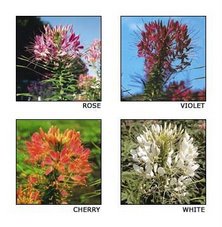
Cleome

Cleome
Cleome is a genus of flowering plants traditionally included in the family Capparaceae. Some recent classifications (e.g. the APG II system have included the Capparaceae within Brassicaceae, while others classifications have transferred Cleome (along with other related genera) to its own family Cleomaceae, separate from both Capparaceae and Brassicaceae.

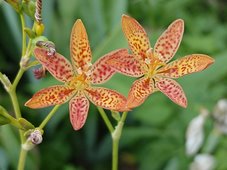
Candy Lily

Candy Lily
Pardancanda norrisii, candy lily. 36". Candy lilies are hybrids between Belamcanda chinensis and Pardanthopsis dichotoma. They are very similar to Belamcanda but with larger flowers in a wider range of colors from blue and purples through yellows, reds, oranges, and bi-colors, with or without dark spots on the petals. Individual blooms last for one day but keep coming for weeks. They have iris like foliage and are often mistaken for iris, especially when they first emerge. Plant Pardancanda in average to rich, well-drained soil in full sun to part shade. Plants divide easily in spring or late summer. Plants often self sow, but the seedlings are easily transplanted or weeded out. If fungul or bacterial leaf spot become a problem, trim off affected foliage and move plants to a location with more sun, better drainage, and better air circulation.

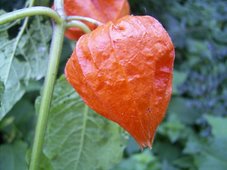
Chinese Lantern

Chinese Lantern
Physalis alkekengi (Bladder-cherry, Chinese Lantern, Japanese-lantern, or Winter cherry; Japanese: hozuki), is a relative of P. peruviana (Cape Gooseberry), easily identifiable by the larger, bright orange to red papery covering over its fruit, which resemble Chinese lanterns. It is native from southern Europe east across southern Asia to Japan. It is a popular ornamental plant, though can be invasive with its wide-spreading root system sending up new shoots some distance from where it was originally planted.

Columbine

Columbine
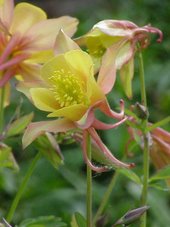
Aquilegia caerulea is a species of Aquilegia native to the Rocky Mountains from Montana south to New Mexico and west to Idaho and Arizona. Common names include Colorado Blue Columbine and Rocky Mountain Columbine, the latter also shared with Aquilegia saximontana. It is a herbaceous perennial plant growing to 20-60 cm tall. The flowers are very variable in color, from pale blue (as in the species name caerulea) to white, pale yellow and pinkish; very commonly the flowers are bicolored, with the sepals a different shade to the petals. Aquilegia caerulea is the state flower of Colorado. It is also a popular ornamental plant in gardens, with numerous cultivars selected for different flower colors. There are five varieties: Aquilegia caerulea var. alpina, Aquilegia caerulea var. caerulea, Aquilegia caerulea var. daileyae, Aquilegia caerulea var. ochroleuca, and Aquilegia caerulea var. pinetorum.

Cornflower

Cornflower
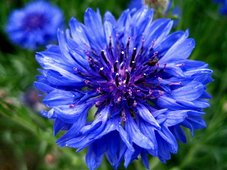
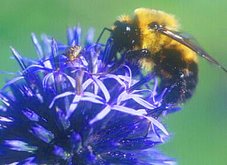
The Cornflower (Centaurea cyanus) also known as Bachelor's button, Basket flower, and Boutonniere flower is a small annual flowering plant in the family Asteraceae, native to Europe. It is an annual plant growing to 40-90 cm tall, with grey-green branched stems. The leaves are lanceolate, 1-4 cm long. The flowers are most commonly an intense blue colour, produced in flowerheads (capitula) 1.5-3 cm diameter, with a ring of a few large, spreading ray florets surrounding a central cluster of disc florets. The blue pigment is protocyanin, which in roses is red. In the past it often grew as a weed in crop fields. It is now endangered in its native habitat by agricultural intensification, particularly over-use of herbicides, destroying its habitat; in the United Kingdom it has declined from 264 sites to just 3 sites in the last 50 years. It is also however, through introduction as an ornamental plant in gardens and a seed contaminant in crop seeds, now naturalised in many other parts of the world, including North America and parts of Australia. It is grown as an ornamental plant in gardens, where several cultivars have been selected with varying pastel colours, including pink and purple. It is also occasionally used as a culinary ornament. Cornflowers have been used and prized historically for its blue pigment. Cornflowers are often used as an ingredient in tea and is famous in the Lady Grey blend of Twinings. In folklore, cornflowers were worn by young men in love; if the flower faded too quickly, it was taken as a sign that the man's love was unrequited. In herbalism a decoction of cornflower is effective in treating conjunctivitis, and as a wash for tired eyes. The Blue Cornflower has been the national flower of Estonia since 1968 and symbolizes daily bread to Estonians. It is also the symbol of the Estonian political party, Rahvaliit, the Finnish political party, National Coalition Party, and the Swedish political party, Liberal People's Party. The Cornflower is also often seen as an inspiration for the romantic symbol of the Blue Flower. The Blue Cornflower was the favourite flower of Kaiser Wilhelm I. Because of its ties to royalty, authors such as Theodor Fontane have used it, often sarcastically, to comment the social and political climate of the time. In Austria it is a political symbol for pan-German and rightist ideas. The Members of the Freedom Party wore it at 2005's Parliament Opening. The Cornflower is the national flower of Poland.

Delphinium

Delphinium
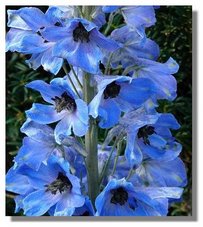
Delphinium is a genus of about 250 species of annual, biennial or perennial flowering plants in the buttercup family Ranunculaceae, native throughout the Northern Hemisphere and also on the high mountains of tropical Africa. The common name, shared with the closely related genus Consolida, is Larkspur. The leaves are deeply lobed with 3-7 toothed, pointed lobes. The main flowering stem is erect, and varies greatly in size between the species, from 10 cm in some alpine species, up to 2 m tall in the larger meadowland species; it is topped by many flowers, varying between purple, blue, red, yellow or white. The flower has five petals which grow together to form a hollow flower with a spur at the end, which gives the plant its name. The seeds are small and shiny black. The plants flower from late spring to late summer, and are pollinated by butterflies and bumble bees. Despite the toxicity, Delphinium species are used as food plants by the larvae of some Lepidoptera species including Dot Moth and Small Angle Shades. Other names are, lark's heel (Shakespeare), lark's claw and knight's spur. The scientific name is taken from Dioscorides and describes the shape of the bud, which is thought to look like a (rather fat) dolphin. The Forking Larkspur (Delphinium consolida) prefers chalky loams. It grows wild in cornfields, but has become very rare nowadays. The flowers are commonly purple, but a white variety exists as well. Baker's larkspur (Delphinium bakeri) and Yellow larkspur (D. luteum), both native to very restricted areas of California, are highly endangered species. Many species are cultivated as garden plants, with numerous cultivars having been selected for their denser, more prominent flowers. All parts of the plant contain an alkaloid delphinine and are very poisonous, causing vomiting when eaten, and death in larger amounts. In small amounts, extracts of the plant have been used in herbal medicine. Gerard's herball reports that drinking the seed of larkspur was thought to help against the stings of scorpions, and that other poisonous animals could not move when covered by the herb, but does not believe it himself. Grieve's herbal reports that the seeds can be used against parasites, especially lice and their nits in the hair. A tincture is used against asthma and dropsy. The juice of the flowers, mixed with alum, gives a blue ink. The plant was connected to Saint Odile and in popular medicine used against eye-diseases. It was one of the herbs used on the feast of St. John and as such warded against lightning. In Transylvania, it was used to keep witches from the stables, probably because of its blue color. Larkspur, especially tall larkspur, is a significant cause of cattle poisoning on rangelands in the western United States. Larkspur is more common in high-elevation areas, and many ranchers will delay moving cattle onto such ranges until late summer when the toxicity of the plants is reduced.

Dianthus

Dianthus
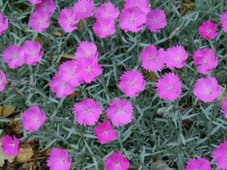
Dianthus is a genus of about 300 species of flowering plants in the family Caryophyllaceae, native mainly to Europe and Asia, with a few species extending south to north Africa, and one species (D. repens) in arctic North America. Common names include carnation (D. caryophyllus), pink (D. plumarius and related species) and sweet william (D. barbatus). The name Dianthus is from the Greek words dios ("god") and anthos ("flower"), and was cited by the Greek botanist Theophrastus. The species are mostly perennial herbs, a few are annual or biennial, and some are low subshrubs with woody basal stems. The leaves are opposite, simple, mostly linear and often strongly glaucous grey-green to blue-green. The flowers have five petals, typically with a frilled margin, and are (in almost all species) pale to dark pink. One species (D. knappii) has yellow flowers with a purple centre. Dianthus species are used as food plants by the larvae of some Lepidoptera species including Cabbage Moth, Double-striped Pug, Large Yellow Underwing and The Lychnis. Also three species of Coleophora case-bearers feed exclusively on Dianthus: C. dianthi, C. dianthivora and C. musculella (which feeds exclusively on D. suberbus). The colour pink may be named after the flower. The origin of the flower name 'pink' is unknown; it has been suggested that it comes from the frilled edge of the flowers, which look as though they were cut with pinking shears, but actually, the shears were patented in 1893 and got their name from the flower.

False Dragonhead

False Dragonhead
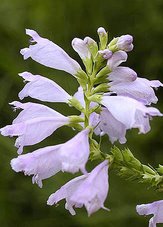
Physostegia virginiana is more commonly known as Obedience Plant or False Dragonhead, since when bent, the stems will take the new shape. Obedience Plant can grow up to 4 feet tall. Small white flowers bloom on the plant in July and August. It will spread by rhizomes, and can spread at a very fast rate. The flowers are usually white, though light pink flowers are also possible. It is a perennial that is native to most of the United States, except for the Pacific Coast states.

Foxglove

Foxglove
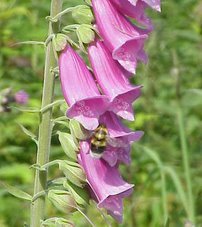
Digitalis is a genus of about 20 species of herbaceous perennials, shrubs and biennials that was traditionally placed in the figwort family Scrophulariaceae. Due to new genetic research, it has now been placed in the much enlarged family Plantaginaceae. The genus is native to Europe, western and central Asia and northwestern Africa. The term digitalis is also used for preparations containing cardiac glycosides, particularly digoxin, extracted from plants of this genus. The members of this genus are known in English as foxgloves. The scientific name means "finger-like", and refers to the ease with which a flower of Digitalis purpurea can be fitted over a human fingertip. The flowers are produced on a tall spike, are tubular, and vary in colour with species, from purple to pink, white and yellow. The best-known species is the Common Foxglove, Digitalis purpurea. It is a biennial, often grown as an ornamental plant due to its showy flowers, that range in colour from purples through to whites, with variable marks and spotting. The first year of growth produces only the long, basal leaves, while in the second year the erect leafy stem 0.5-2.5 m tall develops. The larvae of the Foxglove Pug feed on the flowers of Digitalis purpurea. Other Lepidoptera species feed on the leaves including Lesser Yellow Underwing.

Globe Thistle

Globe Thistle
The Globe Thistle is very interesting if one likes thorny, prickly plants. The leaves are large, deeply cut and very prickly. The stems are silver-white, while the flowers are either white or a grayish metallic blue. The flower heads are round like a ball and are entirely covered with needle-like thistles All of the species bloom from June or July through September. Echinops Rilro has deep steel blue flowers and grows about 3 feet high E. sphaerocephalus is the tallest growing species, attaining a height of from 5 feet to 7 feet with large, white flowers. All the Globe Thistles are distinctive plants and are well adapted to plant in borders, among shrubbery or to use as bold specimen plants. The flower heads, which are excellent for cutting, can be dried and will remain attractive for months, They are also suitable for naturalizing in wild gardens.

Gloriosa Daisy

Gloriosa Daisy
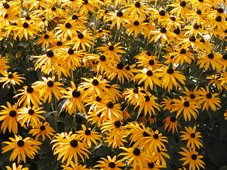
Rudbeckia hirta (common names :Black-eyed Susan, Blackiehead, Brown Betty, Brown Daisy, Brown-eyed Susan, Gloriosa Daisy, Golden Jerusalem, Poorland Daisy, Yellow Daisy, Yellow Ox-eye Daisy) is a flowering plant in the family Asteraceae. It is an upright annual (sometimes biennial or perennial) native to most of North America, and is one of a number of plants with the common name Black-eyed Susan that also has purple on the side. The plant can reach a height of 1-2 m. It has alternate, mostly basal leaves 20-75 cm long, covered by coarse hair. It flowers from June to August, with inflorescences measuring 10-15 cm in diameter (up to 30 cm in some cultivars), with yellow ray florets circling a brown, domed center of disc florets. Black-eyed Susan was designated the state Floral Emblem of Maryland in 1918.

Hen and Chicks

Hen and Chicks
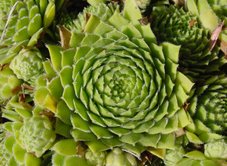
Hen and chicks is a common name for a group of small succulents belonging to the flowering plant family Crassulaceae, native to Europe and northern Africa. They grow close to the ground with leaves formed around each other in a rosette, and propagating by offsets. The 'hen' is the main plant, and the 'chicks' are the offspring, which start as tiny buds on the main plant and soon sprout their own roots, taking up residence close to the mother plant. Plants commonly referred to as "Hens and chicks" include ground hugging species of Sempervivum (Houseleeks) such as Sempervivum Pekinese, Sempervivum arachnoideum (Cobweb Houseleek), and Sempervivum tectorum (Common Houseleek); the related genus Jovibarba. The name is also used for some species of Echeveria, Sedum and Bergenia although these plants differ significantly from, and should not be confused with, Sempervivum and Jovibarba. The description below provides characteristics of Sempervivum and Jovibarba only. Aside from the common morphology, the many species of hen and chicks differ widely in appearance. Colours range from lime green to burgundy to purple, and size varies from as small as 1 cm to as large as 20 cm across. The leaves can be thin and spiky or thick and rounded with a pointed tip. Some, such as Cobweb Houseleek, have fine spiderweb-like filaments that grow naturally from leaf edge to leaf edge, forming a white cover on the top of the plant, while others have fine hairs that cover the entire plant structure. Upon maturity (usually around 3 to 4 years old) the plant will send up a single stalk that can reach 5-15 cm tall. The head of the stalk is a cluster of star-shaped flower buds 1-2 cm in diameter, which range in color from dark pink to yellow and that flower for several weeks. After blooming, the plant will die. Usually by this time it has produced many offsets ('chicks'). Hen and chicks are popular in gardens for their varied and interesting appearance and hardiness. They are grown as container planting or rock gardens. They do best in well-drained, rocky soil; if they stay wet, the outer leaves will rot. Although they do best in sun, they will grow in light shade.

Hollyhock

Hollyhock
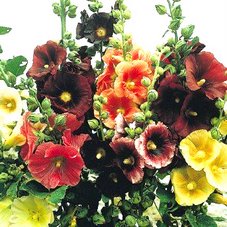
The hollyhocks comprise about 60 species of flowering plants in the genus Alcea (Ál-ce-a) in the mallow family Malvaceae, native to southwest and central Asia. They are biennial or short-lived perennial plants growing to 1-3 m tall, with broad, rounded, palmately lobed leaves and numerous flowers, pink or yellow in the wild species, on the erect central stem. Alcea species are used as food plants by the larvae of some Lepidoptera species including Bucculatrix quadrigemina and the Painted Lady (Vanessa cardui). Hollyhocks are popular garden ornamental plants, cultivars selected, particularly from A. rosea. The flowers have been selected for variations in colour, with dark purple, red and white-flowered plants available in addition to the colours found in wild plants. Hollyhocks are very drought resistant, and do well in full sun locations that might be too hot or dry for other plants. They produce large, flat coin-shaped seeds (1/2" diameter) that seem to grow easily wherever they drop. While an individual plant might only live a handful of years, by that time chances are good it will leave plenty of descendants. They have very long taproots which make transplanting difficult. A stylized, symmetrical hollyhock is the seal of the Tokugawa family in Japan, and is often used as a reference to the era in Japan's history where that family ruled the country.

Jacob's Ladder

Jacob's Ladder
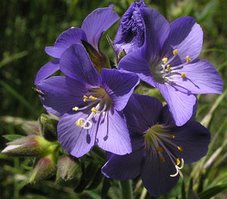
Polemonium foliosissimum is easy to spot and identify because of its growth patterns: it is often in dense to loosely scattered colonies in open mountain meadows; it grows tall (commonly two to three feet) in an open, airy manner; and its leaves are finely cut. Its abundance of softly lavender/ blue/purple flowers are borne in numerous, showy clusters. Altogether, Polemonium foliosissimum is a softly appealing, lovely plant. Charles Parry first found this plant for science in Colorado and it was named by Asa Gray in 1878. "Foliosissimum" is Greek for "very leafy".

Lupin

Lupin
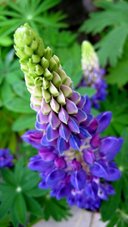
Lupin, often spelled lupine in North America, is the common name for members of the genus Lupinus in the family Fabaceae. The genus comprises between 150-200 species, and has a wide distribution in the Mediterranean region - Subgen. Lupinus, and the Americas - Subgen. Platycarpos (Wats.) Kurl. The species are mostly herbaceous perennial plants 0.3-1.5 m tall, but some are annual plants and a few are shrubs up to 3 m tall, with one, Lupinus jaimehintoniana, a tree 8 m high with a trunk 20 cm in diameter, from the Mexican state of Oaxaca. They have a characteristic and easily recognised leaf shape, with soft green to grey-green or silvery leaves with the blades usually palmately divided into 5–17 leaflets or reduced to a single leaflet in a few species of the southeastern United States; in many species, the leaves are hairy with silvery hairs, often densely so. The flowers are produced in dense or open whorls on an erect spike, each flower 1-2 cm long, with a typical peaflower shape with an upper 'standard', two lateral 'wings' and two lower petals fused as a 'keel'. The fruit is a pod containing several seeds. Like most members of this family, lupins can fix nitrogen from the atmosphere into ammonia, fertilizing the soil for other plants (see legume). The genus Lupinus is nodulated by the soil microorganism Bradyrhizobium sp. (Lupinus). Some species have a long central tap root. The yellow legume seeds of Lupins, commonly called Lupini beans, were quite popular with the Romans and they spread the cultivation of them throughout the Roman Empire. Today, Lupini are most commonly found in Mediterranean countries, especially in Portugal, Egypt, and Italy, and also in Brazil & In Spanish Harlem, where it is popular along with beer. In Portuguese the Lupini Beans are known as "tremoços". In Antalya, Turkey it is known as Tirmis amongst the local people. The Andean American variety of this bean is the Lupinus mutabilis, a widespread food during the Incan Empire. They are commonly sold in a salty solution in jars (like olives and pickles) and can be eaten with or without the skin. Lupins are popular ornamental plants in gardens. There are numerous hybrids and cultivars. Some species, such as Lupinus polyphyllus and hybrids like the Rainbow Lupin (Lupinus × regalis) are common garden flowers. Others, such as the Yellow Bush Lupin L. arboreus are considered invasive weeds when they appear outside their native range. Lupins are also cultivated as forage and grain legumes. Three Mediterranean species of lupin, Lupinus angustifolius (Blue Lupin), Lupinus albus (White Lupin) and Lupinus luteus (Yellow Lupin) are cultivated for livestock and poultry feed and for human consumption. The Andean Lupin Lupinus mutabilis and the Mediterranean L. albus, L. angustifolius[2] and L. hirsutus[3](these varieties are known locally as altramuz in Spain and Argentina) are also edible after soaking the seeds for some days in salted water [4]. These lupins are referred to as sweet lupins because they contain smaller amounts of toxic alkaloids than the bitter varieties. Both sweet and bitter lupins in feed can cause livestock poisoning. Lupin poisoning is a nervous syndrome caused by alkaloids in bitter lupins, similar to Neurolathyrism. Mycotoxic lupinosis is a disease caused by lupin material that is infected with the fungus Diaporthe toxica; the fungus produces mycotoxins called phomopsins, which cause liver damage. The worst damage to lupin is caused by anthracnose, fusarium wilt, fusarium and other root rot, bacteria and viruses.

Mrs. Bradshaw

Mrs. Bradshaw
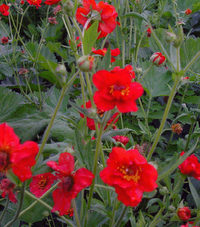
Geum (Avens) is a genus of about 50 species of perennial herbaceous plants in the rose family Rosaceae, native to Europe, Asia, North and South America, Africa and New Zealand. They are closely related to Potentilla and Fragaria. The Geum 'Mrs. Bradshaw‘, Geum chiloense, produces lovely scarlet, semi-double flowers that are shaped like small roses. Its fresh green, fuzzy foliage makes it different from the rest. With a plant height of 3’ and a spread of 12-18”, this is a highly valued plant. ‘Mrs. Bradshaw’ has a long blooming season, from May to July, and is easy to care for. Not bothered by pest or insects, it is one to defiantly try. ‘Mrs. Bradshaw’ needs full sun but can tolerate afternoon shade, in moist well-drained soil. It is a perfect addition to any cottage garden, makes a wonderful combination with bright yellows, gold’s and true blues (like Delphiniums, Salvias), for borders and mass plantings and for cuttings.

Mugho Pine (It's Moo Goo!!! Our First Garden Purchase!!)

Mugho Pine (It's Moo Goo!!! Our First Garden Purchase!!)
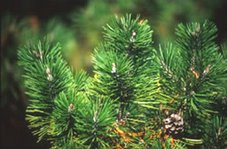
The Mugho Pine tree, Pinus mugo mughus, may also be called the dwarf mountain pine. This evergreen little dwarf conifer has branching, upright stems evenly covered in 2-inch-long needles of a deep, dark true green. Thanks to its low growth, mugho pine can be used at the front of a border or anywhere you want year-round greenery in conifer form. Mugho pine trees do not need special soil. In nature, it often grows in slightly rocky areas with shallow topsoil. It does require good drainage. Roots grow near the surface, so using a cover soil with a 2-inch-thick mulch to protect them is recommended. These trees are easily transplanted. They make a great landscaping evergreen tree because their shape and size are controllable by shearing.

Poppy

Poppy
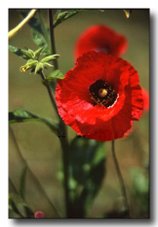
Poppies need to be planted in full sun, in a moist but well drained area. It has a plant height and width of 24" and blooms from May until July. Poppies are best used as cut flowers, as a border plant and as underplantings to larger, late flowering perennials. They do go dormant in July or August, and the foliage will die back completely to the ground. Avoid planting in wide open spaces.

Rhododendron

Rhododendron
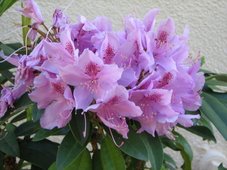
Rhododendron (from the Greek: rhodos, "rose", and dendron, "tree") is a genus of flowering plants in the family Ericaceae. It is a large genus with over 1000 species and most have showy flower displays. It includes the plants known to gardeners as azaleas. The Rhododendron is an interesting genus characterized by shrubs and small to (rarely) large trees, the smallest species growing to 10-20 cm tall, and the largest, R. arboreum, reported to 50 m tall. The leaves are spirally arranged; leaf size can range from 1-2 cm to over 50 cm, exceptionally 100 cm in R. sinogrande. They may be either evergreen or deciduous. In some species the underside of the leaves are covered with scales (lepidote) or hairs (indumentum). Some of the best known species are noted for their many clusters of large flowers. There are alpine species with small flowers and small leaves, and tropical species such as subgenus Vireya that often grow as epiphytes. Rhododendron is a very widely distributed genus, occurring throughout most of the Northern Hemisphere except for dry areas, and extending into the Southern Hemisphere in southeastern Asia and northern Australasia. The highest species diversity is found in the Sino-Himalayan mountains from central Nepal and Sikkim east to Yunnan and Sichuan, with other significant areas of diversity in the mountains of Indo-China, Korea, Japan and Taiwan. In addition, there are a significant number of tropical rhododendron species from southeast Asia to northern Australia, with 55 known species in Borneo and 164 in New Guinea [1]. Relatively fewer species occur in North America and Europe. Rhododendrons have not been found in South America or Africa. Rhododendrons are extensively hybridized in cultivation, and natural hybrids often occur in areas where species ranges overlap. There are over 28,000 cultivars of Rhododendron in the International Rhododendron Registry held by the Royal Horticultural Society. Most have been bred for their flowers, but a few are of garden interest because of ornamental leaves and some for ornamental bark or stems. Both species and hybrid rhododendrons (including azaleas) are used extensively as ornamental plants in landscaping in many parts of the world, and many species and cultivars are grown commercially for the nursery trade. Rhododendrons are often valued in landscaping for their structure, size, flowers, and the fact that many of them are evergreen [5]. Azaleas are frequently used around foundations and occasionally as hedges, and many larger-leafed rhododendrons lend themselves well to more informal plantings and woodland gardens, or as specimen plants. In some areas, larger rhododendrons can be pruned to encourage more tree-like form, with some species such as R. arboreum and R. falconeri eventually growing to 10-15 m or more tall. Like other ericaceous plants, most rhododendrons prefer acid soils with a pH of roughly 4.5-5.5; some tropical Vireyas and a few other rhododendron species grow as epiphytes and require a planting mix similar to orchids. Rhododendrons have fibrous roots and prefer well-drained soils high in organic material. In areas with poorly-drained or alkaline soils, rhododendrons are often grown in raised beds using mediums such as composted pine bark.[7]. Mulching and careful watering are important, especially before the plant is established.

Summer Skies

Summer Skies
SUMMER SKIES is noted for its double flowers. It is a mounding, clump-forming perennial that typically grows to 24” tall and spreads to 24” wide. Features soft, violet-blue double flowers (to 1.25” diameter) with fine dark veining and a hint of greenish-white in the center. Flowers typically bloom from late spring to early summer in hot summer climates such as St. Louis, but may bloom throughout the summer into fall in cooler northern climates. Sparse late summer and/or fall rebloom may occur in St. Louis if plants are cut back hard after flowering. Deeply cut gray-green foliage. Easily grown in average, medium wet, well-drained soil in full sun to part shade. Prefers moist, organic soils. Also prefers part afternoon shade in hot summer climates such as the St. Louis area. Plants may be cut or sheared back after flowering to rejuvenate, shape and/or encourage rebloom. Side stems may be removed or trimmed at any time to control spread. No serious insect or disease problems. Taller stems may need some support. Specimen, group or mass in borders, rock gardens or cottage gardens.

Sweet Million (We GOTTA Have Some Cherry Tomatoes in Our Garden!!)

Sweet Million (We GOTTA Have Some Cherry Tomatoes in Our Garden!!)
Early maturing hybrid cherry type tomato. Clusters of tiny fruit are well rounded, deep red in color with a delicious sweet flavor. Tolerance to cracking and good holding qualities. Tall Indeterminate plants grow tall and require support. Maturity is 60 days from transplanting.

Sitemeter